Pre-Qingming Green: The Life Cycle of Longjing Tea
High in the hills of Meijiawu, the spring race to pick and fire Hangzhou's legendary tea begins before the April rains — free terraces, harvest season, and a clear scam warning.
Published
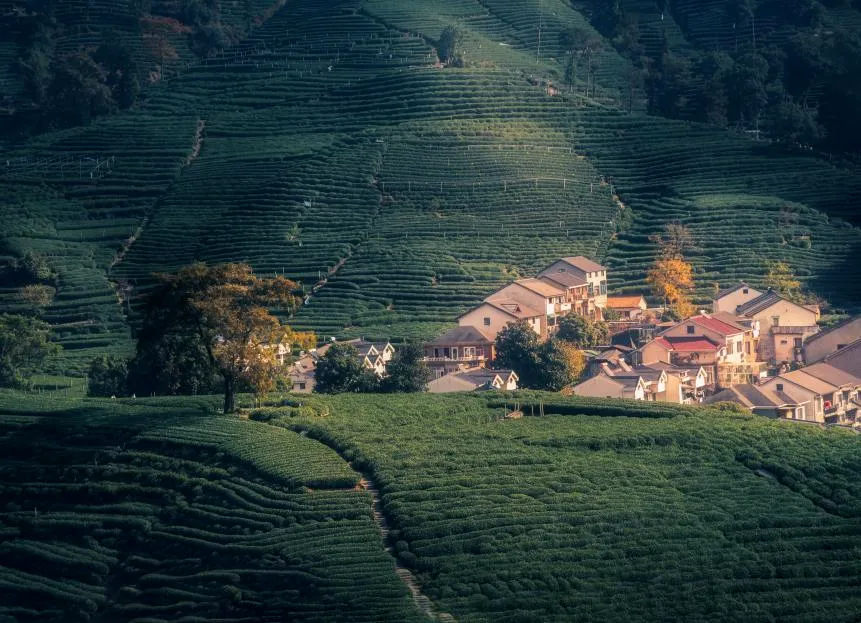
Meijiawu (梅家坞, Méijiāwù) and the Longjing hills southwest of West Lake are free tea terraces where spring Mingqian buds are hand-picked and pan-fired before Qingming rains. Come late March to mid-April for harvest smell and wok work; skip roadside strangers offering "cheap authentic" tea — stick to licensed houses or farmers firing in public.
What do you actually see?
Terraced green bushes under morning fog; women in straw hats plucking bud-and-two-leaf tips; old men pressing raw leaves against ~200°C iron woks until they flatten into jade sword shapes. In village lanes: charcoal smoke, toasty aroma, and glasses of Longjing where leaves float vertical then sink. Hupao Spring, a separate West Lake–area stop, is the classic water pairing when you want the full ritual.
Why does pre-Qingming matter?
Mingqian (明前) leaves must be picked before early-April Qingming rains. After rain, shoots grow too fast and sweetness turns astringent. Roughly seventy thousand tips make one kilogram of finished dry tea. Hand pan-firing (手工炒茶) locks floral oils into the signature flat shape — decades of palm work, not a brochure slogan.
How do you avoid the tea scam?
Friendly strangers offering to take you to a family home for cheap authentic tea are often commission scams — you pay thousands for low-grade leaves grown elsewhere. Stick to established, state-licensed tea houses or buy direct from farmers actively pan-firing by the roadside under neighbors' eyes. If you cannot see leaves being fired, walk away.
When should you go, and how long?
Peak harvest atmosphere runs roughly late March through mid-April. Winter and high summer keep terraces green but rarely show street-side pan-firing. Plan a morning for Meijiawu (bus ride alone 40–50 minutes). Soft pair with a West Lake walk the same afternoon only if energy remains — tea hills first while wok smoke is active.
Hours, tickets, and how to get there?
Entry to Meijiawu village lanes and surrounding tea terraces is free — no single ticketed gate for the hills themselves. Hupao Spring sits as a separate West Lake–area stop with its own sub-attraction rules — confirm on municipal West Lake pages at westlake.hangzhou.gov.cn before pairing it with a Meijiawu morning (checked October 2026).
Take Hangzhou Metro Line 3 to Huanglongdong Station (黄龙洞站), then the nearby bus hub for Bus 103 (and other village-bound routes such as 121 when listed) to Meijiawu Bus Stop (梅家坞站). Individual farmhouse tasting hours are not standardized on a single official https timetable — treat midday village hours as a planning window.
Who is this for — and who should skip?
Come if you want harvest smell, wok watching, and careful buying. Skip if you expect a private plantation tour without commission risk, or a guaranteed Mingqian purchase outside spring. Arrive with skepticism toward free taxi invitations and leave with leaves you saw fired.
More from Hangzhou
- history / 5 min readAn exploration of how legend and literature built West Lake, from the tragic spirits of Leifeng Pagoda to the rain-soaked stones of the Broken Bridge — with verified pagoda hours and free lakeside access.
- history / 5 min readVenturing 5,000 years into China's past through the massive hydraulic engineering and intricate jade carvings of the Liangzhu ruins — free museum, ticketed park, Metro Line 2 plus shuttle.
- food / 5 min readHangzhou's local food, or Hangbang Cai, is a study in understatement—balancing subtle sweet-sour notes with stories of old poets and emperors, best anchored near West Lake and Hefang Street.