Shoulders of Bamboo: The Vanishing Bangbang Army of Chongqing
Carrying wholesale goods up the steep stone cliffs of Chaotianmen, Chongqing's aging bamboo porters are a fading symbol of working-class grit — free to observe around the markets.
Published
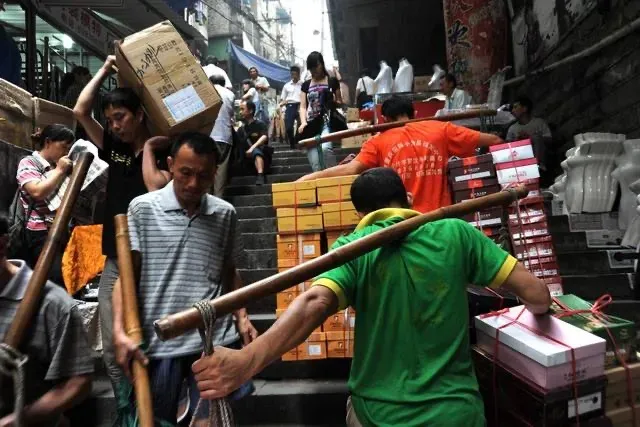
Chongqing's Bangbang Men (棒棒们) are aging bamboo-pole porters still hauling wholesale loads on Chaotianmen's steep market stairs — a fading working-class trade shaped by cliff geography. Watch them free around the textile markets; take Metro Line 1 to Chaotianmen and keep clear of loaded stairs.
What do you actually see?
You hear them first: a sharp rhythmic tapping of green bamboo poles on wet stone. Then the men — usually in their fifties or sixties, faded undershirts catching sweat, rubber-soled shoes gripping slick steps. A thick bamboo pole (棒棒) rests on the shoulder, worn smooth by decades of friction, two green nylon ropes dangling. They hoist loads that can weigh as much as they do and move with a slow swaying rhythm up the stairs.
Why did cliff geography create this job?
Chongqing sits on steep cliffs at the Yangtze–Jialing junction. Historically wheeled vehicles could not climb from river docks to shopping districts above — only thousands of stone steps. Bangbang Men carried crates, fabric rolls, and furniture one load at a time. At their peak in the 1980s–1990s the “Bangbang Army” numbered over 200,000. Highways, cargo elevators, light rail, and delivery apps have shrunk the trade; the porters who remain are aging.
Is this a staged heritage show?
No. These are working professionals, not a photo set. You will still find them sitting on steps outside Chaotianmen market buildings, poles across their knees, waiting for a merchant who needs a heavy roll moved through a corridor where handcarts cannot fit. Soft pair: Liziba's monorail-through-building shows the modern vertical city that is replacing their stairs.
When should you go, and how long?
Spring and autumn (March–May, September–November) keep stairs less slippery than midsummer humidity. Soft fact (checked October 2026): wholesale floors are typically busy from mid-morning into the afternoon — treat morning through late afternoon as the practical window and confirm on arrival. An hour of respectful observation is enough.
Hours, tickets, and how to get there?
Observation around the Chaotianmen wholesale markets (朝天门市场) is free — working merchant floors and stairs, not a ticketed scenic park. Take Chongqing Metro Line 1 to Chaotianmen Station (朝天门站) and walk toward the clothing and textile market buildings above the river confluence. No single official https timetable locks merchant hours. Photograph from a respectful distance without blocking narrow staircases; loaded porters cannot easily stop or swerve.
Who is this for — and who should skip?
Come if you want working-class grit and cliff logistics still visible in a city of monorails. Skip if you expect a staged heritage performance or guaranteed English signage. In a city that prides itself on slick transit, these men remain a quiet reminder of the muscle that carved Chongqing out of the cliffs.
More from Chongqing
- history / 5 min readExplore Chongqing's wartime air-raid shelters and two free museums — Stilwell near Liziba and Hongyan — with verified hours and Monday closure.
- history / 5 min readA journey to the Song and Tang dynasty sandstone grottoes of Baodingshan in Dazu — verified hours, tickets, and rail transfer from Chongqing.
- food / 6 min readCommunal, sweat-inducing, and thick with beef tallow, Chongqing's bomb-shelter hotpot is a sensory trial of chili and Sichuan pepper — Zhongshan Sanlu and Liziba anchors.